Showing posts with label History of Haiti. Show all posts

Tuesday, August 17, 2010

US academic and polemicist Noam Chomsky (file photo)
Photo: AP
US academic and polemicist Noam Chomsky (file photo)


An international group of writers and academics is calling on France to reimburse Haiti $21 billion that the Caribbean nation was forced to pay to secure its independence 200 years ago.

The group, which includes journalists and members of the European parliament, made the appeal to French President Nicolas Sarkozy in an open letter published Monday in the French newspaper Liberation.

American linguist Noam Chomsky and other signatories said France should repay Haiti's independence debt in light of the former French colony's "urgent" need to recover from a devastating earthquake in January. They called the 19th century payment demand by French slave owners seeking compensation patently illegitimate and illegal.

Critics say international donors have not fulfilled their pledges of aid to Haiti, where the earthquake killed some 230,000 people and caused $7 billion in damage.

Haiti became the world's first independent black republic in 1804 as a result of a successful slave revolt against French colonial rule.

In 1825, French monarch Charles X demanded Haiti pay 150 million gold francs to French slave owners as compensation or face invasion and a restoration of slavery.

Haiti continued making the payments until 1947, transferring to France a reduced debt of 90 million gold francs, valued today at $21 billion.

In 2003, then-Haitian President Jean-Bertrand Aristide also demanded that France repay the money. Monday's letter accuses Paris of responding to that demand by helping the effort to oust the Aristide government a year later.

Mr. Aristide left Haiti in February 2004 during an armed rebellion and violent protests by Haitians who accused him of corruption and intimidating opponents. He has been living in exile in South Africa.

The former Haitian president said after the earthquake that he was willing to return to his country to help rebuilding efforts.  His offer has not been accepted.

Some information for this report was provided by AFP.

Source Voanews.com

Thursday, April 8, 2010

Haiti's Declaration of Independence Found in British Archives

 07 April 2010                                                                                                         Jennifer Glasse | London

The only known copy of Haiti's Declaration of Independence has been discovered by a Canadian graduate student in Britain's National Archives. In the 1950s historians tried and failed to find the declaration for Haiti's 150th anniversary.

On January 1, 1804, former slaves proclaimed the independence of their country Saint-Domingue from France, declaring the new nation be named Haïti. Though it was known that documents declaring the country's emancipation were printed, none had ever been found.

That's until a Canadian graduate student tracked it down recently, tucked away in Britain's National Archives.

Duke University graduate student Julia Gaffield was doing research in France and in Haiti, and found reference to a printed declaration in a Jamaican library. Jamaica was then a British Colony, so she came here to London, to search the British archives.

"I didn't quite expect to find it because, you know, obviously there have been no copies anywhere else, but I knew there was a chance and I guess I was just hoping," she said.

When she turned the pages in the bound letter book that held documents from 1804 she found a cover letter from the governor of Jamaica and Haiti's Declaration of Independence.

"I was slightly surprised by what it looked like because it was in pamphlet form rather than a large proclamation that would be posted up in a public space, so you know it's this very grandiose and spectacular document, but the presentation of it was kind of underwhelming I guess," she said.

Historian Alex von Tunzelmann says the discovery is important because it gives a look into the only country in the Western Hemisphere where slaves successfully revolted to gain national independence.

"This was a slave colony that had risen up and defeated the white colonial rule and then become independent, the first real successful really slave revolt in history," he explained.

Gaffield says it set a precedent. "It is the second declaration of independence ever issued and in a way set the standard for what would come," she said. "The American declaration was the first, but since Haiti followed suit it then became the typical thing you do when you become independent, you issue an official declaration of independence."

The seven-page document is in French and starts with the words Liberty or Death, echoing the battle cry of the American Revolution, "Give Me Liberty or Give Me Death." It concludes by asking the people of Haiti to take an oath to "live free or die, to uphold the independence of Haiti until their last breaths."

While historians had already known the contents of the document, Gaffield says it was still moving.

"It's an emotional document, it's a poetic document," she stated. "I often think of it as a call to arms and an expression of the fact that the fight for independence was not over yet."

Gaffield says one measure of success of that fight is that Haiti exists today. In the wake of the country's devastating earthquake In January, she says finding this document is even more special.

"So much has been lost in Haiti right now and it's a wonderful feeling to be able give something back," she said. "And to remind Haitians and the world that Haiti has a pretty great history that was very powerful and world changing."

Gaffield is a couple of years from finishing her doctoral dissertation that led her to find Haiti's Declaration of Independence. She says there could still be a lot of documents about the country's history yet to be found.

(Source: http://www1.voanews.com/english/news/americas/Haitis-Declaration-of-Independence-Found-in-British-Archives-90092852.html)

Sunday, January 3, 2010

Haiti has a new first lady (December 6, 2009)


Written by Jacquelines Charles

Ladies, René Préval is no longer a bachelor.

Haiti’s twice-divorced president is now married.

In a private 11 a.m. ceremony Sunday, Préval married Elisabeth Débrosse Delatour at Delatour’s home in Furcy, a suburb of Port-au-Prince.

Delatour, a widow and mother of two, was married to Leslie Delatour, the former governor of Haiti’s central bank. She also is one of Préval’s economic advisors.

About 50 close family members and friends attended the low-key nuptials. He wore a white suit, she a beige dress and hat.

Préval began his second presidential term in 2006 as a single man. This is the second time he has married while in office. During his first presidential mandate, he married Jerry Benoit at the palace, also in a low-key ceremony.


Préval, 65, who is entering the final year of his second presidential mandate, is taking a two-day honeymoon with his 47-year-old bride. He returns to work at the presidential place on Wednesday.

(Source http://www.miamiherald.com/news/americas/haiti/story/1370063.html)


Friday, January 1, 2010

January 1st 1804- January 1st 2010

Can't believe it: my first blog for this year!
Yes, if you can read this post it means you have made it this far! Haiti is 206 years old! We are officially celebrating our 206th year of independence. For a country which has been independent for that long we surely have a long way to go! But you know what, it is not impossible! Many others did it so why can't we?

This past decade has been a heck of a decade for Haiti! As we are focusing on this new year let us remember to be united. It is ok to have different opinions about things but we should not fight over our opinion but instead, we should sit down together and find a way where we are able to meet each other in the middle.

If you want to go to Haiti and see a whole new side of it, just make sure you go to labadee in Cap Haitian, I think this is a big jump for the country touristic wise and I urge you to keep the momentum going! There are other places as well so if you know some more just let us know about it.

I encourage you to help Haiti as much as you can! Help somebody learn a trade or form someone to form others. Education is the key!

I am really looking forward to this new year and hope you are too.
Have a happy new year! Don't forget if you see any subject you would like to say something about just make sure you leave your comments on the blog!

Lerez ane! Happy new year!
Sammuel!

Wednesday, December 16, 2009

Chritmas in Haiti!

Chritsmas in Haiti is something else! One would think about cold weather, snow or sleet! In Haiti in most of the places it's mostly heat and sweat! To tell you the truth it gets a little cold around the moutains area but you know for someone who is used to the cold this is absolutely nothing! I don't even think it gets in the 50's I would say rather the lowest temperature  would be in the lower 60's.

Christmas in Haiti is different than industrialized countries cause people do not have that much to spend. Nevertheless it is as important as it is all over.

I remenber as little boy the only time I will be up till midnight would be on Christmas eve and new year eve. On christmas eve December 24th, we have a big celebration at church with a lot of food. I loved to do plays specially those involving eating. You get to act but by acting you are actually eating the food for real! I used to love that!  I can also remember as soon as I hear the first Christmas song on the radio by the middle of October that it is time to be as nice as one can be so that you will get a present. Sweet memories! In the neighborhood I used to live in there would be hundreds of people walking the streets, going to different church services or parties! Everyone is happy!

But unfortunately, there is this category of people who are too poor to afford any christmas gifts or parties! They stay at home praying for Santa to come to see about them if he really exists!

I find that the christmas carols are very sads cause as opposed to the USA it is not about mistletoe or elf or rudold but it is about asking Santa to do something for the country, it is about asking Santa doesn't he have a map to their house, will he bring them electricity, food or anything that we take for granted in the industrialized countries. I don't know if you've heard the Christmas shoes story, it reminds me of people who just can't celebrate as we are! Let's us once again be thankful for being able to celebrate and pray and act for those who can't! there is nothing more beautiful than making a kid smile with a gift he did not even expect!

As we are celebrating Christmas this year, let us think about these people who are just like us except that they are in an unfortunate situation! Let's do something for them, pray for them yes but do something for them them even better. If you can't do something directly, please help someone who is doing something! Let's make this Christmas more about others and less about us! Let's give without expecting anything in return which is the real meaning of Christmas for me! How much do we owe Jesus? How long would we have to pay till we pay him back for coming to earth and live amongst us sinners! We did not deserve it, but he values us and lay down his life for us! Let us do something special for another who can't afford it!


 No matter what people want to say! Jesus is the reason why we are celebrationg so let's make it more about him that anything else! Teach your kids about the story of the birth of Jesus and teach them to give and not to only receive! You will not regret it!

Do you have a special Christmas story that you would like to share! May be there is a special tradition in your family, your community or your own country, please let us know about it!

From my family to yours have a merry Christmas and remember that Jesus is the reason for the season! There can't be any Christmas without Christ!

Wednesday, November 18, 2009

Today in Haiti's history/ Bataille De Vertiere

 Today is a holiday in Haiti! Since this day played a crucial point in our independence. It used to be called the Day of the Army as well since the army was dissolved it is just Battle of Vertière. Vertière is just a place 
The battle of Vertière, the last large battle of the Haitian Revolution (Haitian war of independence) was fought between Haitian rebels and French expeditionary forces on November 18, 1803 at Vertières.
Haitians led by Jean-Jacques Dessalines attacked a strong French-held fort of Vertierre, near Cape Français (to the north of Haiti) and won a decisive victory over French colonial army under General Comte de Rochambeau and forced him to capitulate the same night. Haitian Ninth Brigade under François Capois played a crucial role in the victory.
As a result, independent Republic of Haiti was proclaimed on December 1, 1804.
November 18 has been widely celebrated since then as a Day of Army and Victory in Haiti.

Now... Let's go deeper in the history for those of you who are more inquisitive:

The Battle of Vertieres (Kreyòl: Batay Vètyè; French: Bataille de Vertières), a defining campaign in the Haitian revolution, took place on November 18, 1803. In this clash, south of Le Cap Haitians led by Jean-Jacques Dessalines and Alexandre Pétion ultimately defeated the French troops under General Rochambeau.


The last and defining Battle of the Haitian Revolution


This last large battle of the Haitian Revolution, the Haitian War of Independence, was fought between Haitian rebels and French expeditionary forces. This decisive blow was a major loss for France and it's colonial empire. Haitians led by Jean-Jacques Dessalines and François Capois attacked a strong French-held fort of Vertières, near Cap François (in the north of Haiti) and won a decisive victory over French colonial army under General Comte de Rochambeau and forced him to capitulate the same night.
The Haitian Ninth Brigade under François Capois played a crucial role in the victory and caused Napoléon's troops to abandon their stronghold. This battle occurred less than two months before Dessalines declaration of independence (On January 1, 1804) and delivered the final blow to the French attempt to re-institute slavery, as had been the case in the other Caribbean possesions, and to stop the Haitian Revolution.
Another leader of the fight at Vértieres was Louis Michel Pierrot, the husband of the mambo Cécile Fatiman who had led the vodou ceremonies at Bois Caïman on August 14, 1791 together with Boukman.

The first major defeat of Napoléon's army

Napoléon Bonaparte, who had come to power three years prior to the Battle of Vertières (Through a coup d'etat on November 11, 1799), was given his first major defeat when he lost this crucial battle against the Haitian revolutionary forces. The French lost many experienced troops in the last year of fighting (1803) in Saint-Domingue and after the Battle of Vertières, their military and political strength in the Western Hemisphere was significantly weakened.
Even though Napoléon had mobilized about 30.000 troops that, in 1802, sailed in huge fleets from France to re-establish slavery in it's most profitable colony [Saint-Domingue], and had given up control over much of the territory he controlled in the Americas (see: The Haitian Revolution and the Louisiana Purchase), the Haitian troops commanded by Toussaint Louverture and later Jean-Jacques Dessalines won the war, culminating in the Battle of Vertiéres. This defeat, the French troops fled for France soon after loosing the final battle, was a major blow to the French empire, having been cut of from it's biggest source of income: the profits of plantation slave labor in Saint-Domingue.
For the Haitians, who would soon declare independence, the outcome of the battle of Vertiéres signaled the final defeat of the cruel treatment they had to suffer from the hands of the French colonizers. Rochambeau's defeat is still seen as a milestone in the fight against slavery and paved the way for the abolition of slavery in other countries, although Haiti was the first black republic in the hemisphere and the first nation to rid themselves from the terrors inflicted by the European colonialists.
The Battle of Vertières is a monument to Haiti's achievements as well as that of it's outstanding military leader at the time: Jean-Jacques Dessalines. Toussaint Louverture, who had died in April of 1803 in French captivity at Fort de Joux, had laid the groundwork for the defeat of France. It was Jean-Jacques Dessalines, who carried on as the leader of the Haitian troops and united the revolutionary forces, that made the win over the cruel General Rochambeau a possibility.
"[Rochambeau's] ferocious and sanguinary spirit was too much for the kind heart of Toussaint, or the gentlemanly bearing of Christophe. His only match was Dessalines." (Wells Brown p. 111)

Battle of Vertières' Day

November 18 has been celebrated since then as the Bataille de Vertières day (Battle of Vertières' Day) this day also used to be Armed Forces Day (French: Jour Des Forces Armées) in Haiti. President Jean-Bertrand Aristide abolished the Haitian army in the early 1990's.


(source haitianmedia.com, thelovertureproject.org)

Thursday, November 12, 2009

National Anthem Singing contest update!


We have teamed up with Haitian Treasures since they do a good job promoting Haiti. Please buy they products and visit their website. More info about the National Anthem singing contest ! If you have a website please promote this event for the sake of our country and pass it on to your friends and family, your church, youth group, this can also be a school project! The possibilities are endless!

We are all waiting for you!

Thursday, January 1, 2009

Happy birthday Haiti! Jan 1, 1804- 2009

Photo Sharing and Video Hosting at PhotobucketPhoto Sharing and Video Hosting at PhotobucketPhoto Sharing and Video Hosting at Photobucket
What a great way to start the first blog for the new year! I am so honored to do so. Today is Haiti's birthday! Our nation was born on this day in 1804 when our ancestors chased the mighty army of Napoleon out of the country. It was a bloody battle nevertheless we ended up being the first black independent country in the whole hemisphere and an inspiration for many other countries.

Let it be known that Haiti fought for many countries before and after it's independence. I will however focus on special one that is unfortunately not well know it is called the "siege of Savannah" as a matter of fact a monument was erected in Savannah in remembrance of these courageous Haitian soldiers including a Haitian teenage boy drummer: Henri Christophe who later became president and built the famous Citadelle in the Cap Haitian. Haiti is 204 years old! We have a long way to go, nevertheless we should never give up! Enjoy your squash soup (if you do not know what I am talking about please read squash soup history and go to our famous squash soup recipe
Since I focused more on the USA let me as well let you know more about: H.RES.909
Title: Commemorating the courage of the Haitian soldiers that fought for American independence in the "Siege of Savannah" and for Haiti's independence and renunciation of slavery.
Sponsor: Rep Meek, Kendrick B. [FL-17] (introduced 12/19/2007) Cosponsors (32)
Latest Major Action: 2/12/2008 Passed/agreed to in House. Status: On motion to suspend the rules and agree to the resolution, as amended Agreed to by the Yeas and Nays (2/3 required): 361 - 0 (Roll No. 44). (Link/source: http://thomas.loc.gov/cgi-bin/bdquery/z?d110:h.res.00909)

H. RES. 909

Commemorating the courage of the Haitian soldiers that fought for American independence in the "Siege of Savannah" and for Haiti's independence and renunciation of slavery.

Photo Sharing and Video Hosting at PhotobucketPhoto Sharing and Video Hosting at PhotobucketPhoto Sharing and Video Hosting at Photobucket

IN THE HOUSE OF REPRESENTATIVES

December 19, 2007

Mr. Meek's (for himself) submitted the following resolution:

RESOLUTION

Commemorating the Haitian soldiers that fought for American independence at the "Siege of Savannah," during the American Revolutionary War.

Whereas in the fall of 1779, Haitian soldiers of the Chasseurs-Volontaires de Saint Domingue
volunteered to join in the fight for American independence;

Whereas the unit was comprised of over 500 men of color from the island of Haiti;

Whereas on October 9, 1779, the soldiers of Chasseurs-Volontaires de Saint Domingue
served as the largest unit of soldiers of African descent to fight in the
"Siege of Savannah;"

Whereas records show that over 500 men sailed treacherous waters to join the effort against
the British;

Whereas over 300 of them lost their lives attempting to drive the British from Savannah;

Whereas the Savannah Monument, a project of the Haitian American Historical Society
represents the Haitian soldiers that fought in the "Siege of Savannah;"

Whereas the Savannah Monument was erected in Savannah, Georgia on Monday,
October 8, 2007 to recognize the Haitian involvement in the fight
for American independence; and

Whereas the Savannah Monument includes a statute of a 12-year-old drummer boy,
depicting Mr. Henri Christophe, whom became a leader in Haiti's Revolution
to gain independence and renounce slavery: Now, therefore, be it

Resolved, That the House of Representatives commemorate the courage of the Haitian soldiers that fought for American independence in the "Siege of Savannah" and for Haiti's independence and renunciation of slavery.

U.S. Rep. Kendrick B. Meek represents the 17th Congressional District of Florida which includes parts of Miami-Dade and Broward Counties. He serves on the House Committee on Armed Services and is the lone Floridian sitting on the House Committee on Ways and Means.
(Source/link: http://kendrickmeek.house.gov/press/2008.02.12b.shtml)
Photo Sharing and Video Hosting at PhotobucketPhoto Sharing and Video Hosting at PhotobucketPhoto Sharing and Video Hosting at Photobucket

Sunday, June 15, 2008

Revolution, Independence, and the New Year

Haiti's Soup Joumou
(e-SoupSong 32: December 1, 2002)

ONCE UPON A TIME, the people of Haiti had special cause to celebrate on New Year's Day. It was January 1, 1804, and after a savage 13-year struggle against their French masters, they had at last achieved independence.

What better way to celebrate than with the very soup they had been forbidden as slaves to eat? Ahhh, soup made from joumou, the delicious and aromatic pumpkin, so different from their usual daily allotment of precisely one ounce of salted meat or fish and one bottle of lemonade. During the independence celebration that happy day, so the story goes, a huge kettle of pumpkin soup was made in the city of Gonaïves, and everyone present was served a bowl. Why? A special communion to forever forge the bonds of brotherhood and commit to a bright national future.

I wish it had been that easy.

Haiti: that "pearl of the Antilles"; that "only successful slave uprising in the history of the world"; that "eldest daughter of France and Africa" that rejected its European heritage--it hasn't been an easy road. In fact, it's been said that far more blood has spilled there than sweat, and there's no counting the buckets of sweat that were shed by 700,000 slaves over 100 years on some 7,000 sugar, coffee, cocoa, cotton, and indigo plantations.

What nation today is routinely excluded from travel guides on the Caribbean? Haiti.

What nation has the lowest literacy rate in the Americas? Haiti.

What people, caught in the crosshairs of historical karma and environmental disaster, have the lowest daily calorie intake in the western hemisphere? Haitians.

From the time King Ferdinand of Spain congratulated Columbus on his Christmas day landfall near Cap Haïtien then declared open season on West Africans for his New World sugar plantations there, Haiti has been a land of warm and gracious people racked by violence and suffering.

Here's some history behind that heavily symbolic kettle of new year's soup: After the 1492 landfall, Spain stayed long enough to kill off the native Arawaks with Old World diseases, import sugar cane cuttings from the Canary Islands, and establish plantations with African slaves...but then left Haiti to the French in 1697 (Peace of Ryswyck) when she found easier pickings elsewhere in the New World.

France wasted no time. Under Kings Louis XIV, XV, and XVI, she transformed those depopulated mountains and valleys into cash crop factories of sugar, indigo, and cotton. How? With 2,500 African slaves in 1698...that jumped to 10,000 in 3 years...and to over 500,000 by 1791--culled largely from tribes in Congo, Angola, Dahomey, Guinea, and Senegal. Their treatment was so horrific, so inhuman, that I haven't the heart to tell. They died like flies and had to be constantly replaced by new shipments from Africa.

So what happened in 1789 when the French people rose up and proclaimed Liberté! Egalité! Fraternité!? After all, the French National Assembly's Declaration of the Rights of Man clearly stated, "Men are born and remain free and equal in rights."

Oh, well. Ahem. National Assemblymen in Paris said, oh yes, we guess that means Haiti too...or at least the freed mulattoes there, those fine sons of Frenchmen and their African slaves. No way, said the racist colonialists in Haiti--and they conducted such a tough lobby that the National Assembly reversed itself in 1791.

Haiti's mulattoes could not believe their ears. It was the last straw. They immediately joined their education, knowledge, and considerable military experience to those 500,000 enslaved Africans--and Haiti exploded in revolt. In August 1791, Vodou priest Boukman Duffy convened slave rebel leaders in the forest overlooking Le Cap. Illuminated by flashes of lightening, they made incantations...they slit the throat of a pig and drank its blood...and they formally swore death to all blancs, which they carried out to the letter with pruning hooks, machetes, and fire. In November, Louis-Jacques Bauvais' mulatto troops attacked and burned Port-au-Prince, slaughtering whites wherever they found them. They sported white ears as cockades in their caps and committed atrocities against women and children I just don't have the heart to tell.

And that was just the start.

Great leaders arose to lead the revolution. Ill-fated Toussaint L'Ouverture, who died in a French prison lamented by poet Wordsworth: "Thy friends are exultations, agonies/And love, and man's unconquerable mind." Henri Christophe. Jean-Jacques Dessalines. And these former slaves led their people first against their colonial masters, in the name of the French Republic. Then against Spain and England, who pounced, chops slavering, when they saw the Pearl of the Antilles slipping from French hands. Then, finally, against France herself, when First Consul Napoleon sent brother-in-law Leclerc and 55,000 crack officers and men instructed to, as he confided to foreign minister Talleyrand, annihilate the government of blacks in Haiti and restore slavery at the first opportunity. "Rid us of these gilded Africans," Napoleon later said, "and we shall have nothing more to wish."

Thirteen long years, all told, of tit-for-tat torched cities, slit throats, scorched earth, attacks, betrayals, mass executions, sieges, torture, encirclements, and despair, not to mention 10,000 deaths from malaria and yellow fever. Dessalines' ultimate winning strategy: koupe tèt, boule kay, cut off the heads, burn down. In the end, some 300,000 Haitians died and 50,000 French--and in the end, the French were defeated. General Rochambeau was given 10 days to pack up his army and ship home.

Which brings us back, harrowed, to the dawn of 1804 and that kettle of soup joumou.

When the last French ship had cleared Le Cap, Dessalines sent word to Gérin at Les Cayes: "There is no more doubt, mon cher général, the country is ours, and the famous who-shall-have-it is settled." In Gonaïves, he divided up the war chest--8 gourdes per man; he dispersed his army to the principal towns; and he sat down with his generals "to ratify in ink what they had written in blood."

On January 1, 1804, people started gathering at dawn at Gonaïves' Place d'Armes. Dessalines mounted the Autel de la Patrie to speak. He recited the cruelties of their enslavement in Kreyol, so everyone could understand him, and he declared that Haitians would forever after live free and die free. "Long live independence!" he shouted at the end of the ceremony, having no idea what a difficult life it would be. Cannons were fired; church bells, rung; people cheered; and, they say, kettles of fragrant soup joumou perfumed the air, ready to be ladled up in a mass communion.

It's a great image. No wonder this soup has become the touchstone of Haiti's fervent wish for peace and freedom--its symbol of communion and brotherhood--a beacon that shines through today's dark days of poverty and continuing political strife. One thing is sure, on January 1, Haitians around the world make it and eat it and share it precisely to remember the past and to hope for the future.

Oh, and there are lots of other stories about soup joumou too. Some say, pure and simple, it's a good luck charm for the new year--and you better eat it cause it's bad luck if you don't. Others say, no, it's really to cleanse and purify the body for the new year...and don't eat anything else til midnight, when you can eat an orange and count your luck in the coming year by its number of seeds. Others yet say it honors the Vodou god Papa Loko, keeper of African spiritual traditions, and that it reliably "lifts up a man's soul and makes him prophesy."

There's something to that last comment. This is a fabulous stuffed soup--bright yellow-orange and sensuously African with an opulence of meat, vegetables, and the Caribbean bite of lime and chilis. In Kreyol, you'd say it was stuffed with vyann, joumou, kawot, seleri, zanyon, nave, pomdete, malanga, and shou...and spiced with piman bouk, ten, lay, and sitwon.

Pat Solley

Resources: Alix's Corner at Discover Haiti website, Madison Smartt Bell's All Soul's Rising, Roseline Ng Cheong-Lom's Haiti, Devra Dedeaux' Sugar Reef Caribbean Cookbook, James Ferguson's Traveler's Literary Companion to the Caribbean, Robert and Nancy Heinl's Written in Blood: The Story of the Haitian People, 1492-1971, National Assembly of France's "Declaration of the Rights of Man and of the Citizen," 8/26/1789, The Oxford Book of Caribbean Short Stories, Mirta Yurnet-Thomas' A Taste of Haiti, William Wordsworth's Collected Poetry, and an assortment of encyclopedias, articles, and websites.
this article is available in its entirety at: http://www.soupsong.com/zdec02.html

Haitian independence and squah soup recipe!

In the US on independence day (4th of July) people do barbecue, they have private and public firework display and parades. In Haiti, we celebrate independence in our unique style. Of course we have parade and celebrations but the most important part of it is what we eat on this day!

Haitians are very proud of their country! Evendo the political and economical situation is at a very low point (at least I know I am proud myself and will always be!) Anyway, on January first it is imperative that we eat squash soup. Why squash soup: just to put it in a nutshell: during French colonization, the French masters would always have soup for celebrations but the slaves were forced to have corn mill but forbidden to ever have squash soup. On January 1st 1804 in order for us to really feel we are free of slavery Jean Jacques Dessalines to his wife to cook squash soup for the former slaves so everyone was happy to be able to have what the masters would have for their celebrations. Ever since, it has become a tradition. So squash soup is the symbol of our liberty, our independence.


Man, I am telling you this thing is so good!!!

Here is the recipe that I got from recipelink.com

Haitian-style Squash Soup

3 pounds beef short ribs, cut into 2-inch lengths
1 lime, sliced
4 (or less) garlic cloves, peeled
2 green onions, including green parts (chop off ends if scraggly), cut into 1-inch pieces
3 to 6 sprigs fresh parsley
1 cube of Knorr Caldo con Sabor de Pollo (chicken bouillon)
1 or 2 tablespoons Maggi seasoning sauce
2 envelopes of Goya Cubitos en Polvo Caldo de Pollo (powdered chicken bouillon)
1 packet of Goya Sazon con culantro y achiote (coriander and annatto)
1 or 2 tablespoons tomato paste
1 or 2 tablespoons butter or margarine

Soup Vegetables
1 large buttercup squash, peeled, seeded and cut into large chunks
4 stalks celery, cut into 1-inch pieces
1 leek, including green parts (chop off ends if scraggly), cut into 1-inch pieces
2 rutabaga, peeled and cut into 3/4 or 1-inch pieces
1 head of cabbage, tough outer leaves removed, roughly chopped
Bouquet of 3 fresh parsley sprigs and 3 fresh thyme sprigs
1/4 cup butter or margarine
1/3 to 1/2 pound rigatoni

In a large mixing bowl or well-scrubbed kitchen sink, place beef and rub generously with lime slices. Cover with nearly boiling hot water and let soak. Meanwhile, in a blender, combine garlic, green onions, parsley, chicken bouillon cube and 1 cup water, process until mixture is smooth and evenly colored.

In a large stockpot or Dutch oven, place (drained) beef and season with Maggi seasoning sauce, Cubitos en Polvo Caldo de Pollo (powdered chicken bouillon) and Sazon con culantro y achiote. Next, add pureed garlic-green onion mixture from the blender, 4 cups water, 1 tablespoon each of tomato paste and butter. Bring mixture to a boil, reduce heat to medium-high and cook for 45 to 60 minutes or until meat is tender, possibly 1 and a half hours.

Meanwhile, in a large stockpot, place buttercup squash and cover with plenty of water (about 2 or 3 inches above squash). Heat pot over medium-high heat and cook until squash is soft, about 30 minutes. Remove from heat and cool slightly. Working in batches, puree squash and pot liquid in a blender or food processor until texture is smooth and creamy. Return pureed squash mixture to a clean pot.

Add beef with pot liquid, celery, leek, rutabaga, cabbage and parsley-thyme bouquet. Bring mixture to an active simmer and cook, covered, for 25 minutes or until vegetables are tender. Add butter and rigatoni and cook, uncovered, until pasta is al dente and soup has thickened. Remove bouquet and discard. Serve immediately.

Makes 10 to 12 servings.

Man! I am hungry! Aren't you?

Saturday, June 14, 2008

History of the flag

For a country’s citizens, the national flag is indisputably a symbol of general pride. They would consider any offense to their flag to be an offense to their country. Beyond being an icon though, a flag’s origin can often say a lot about a nation’s social make-up or history. Haitians feel no different and even reserve a special day to honor it. That day is May 18th.

Jean Jacques DessalinesIn Haiti, Flag Day is a major national holiday celebrated with great fanfare on the grounds of the national palace. Flag Day is also observed by Haitians in the Diaspora. In The United States for example, teenagers whether in High School give homage to the red and blue by carrying it around with them or on their persona for at least a week. Haiti’s flag’s origin is tightly linked to a history of struggle for freedom.Toussaint Louverture

In the early days of revolt in St. Domingue, the slaves did not have a flag. However, they did notice that their former masters were using the French Flag. From 1791 to about 1793, the revolt became more widespread and gave rise to a number of large groups still fighting independently. In those times, each main leader would use any piece of cloth as a flag. Slowly the slave movement found some synergy and came to follow the leadership one main person: Toussaint Louverture. Realizing that you cannot fight three enemies at the same time, Toussaint and the army of revolted slaves fought successively for the Spanish against the French (1793-1794), for the French against Spain and England (1794-1802) and ultimately against France. As such, he carried the color of whichever European power he was fighting for. He later realized that it was silly to use the same flag as the enemies. He then invented his own flag, which was a white piece of cloth with a Negro head to represent the blacks.

After Toussaint’s deportation, The Indigene Army went back to the French flag for a while. A little explanation is needed here: The French flag as we know it now is a product of the French Revolution. It was made up of Red and Blue, the colors of the City of Paris, and a band of white representing the monarchy (La Nation, la Loi et le Roi –). On the white portion of the flag was the emblem of the French Republic. The Revolution of St. Domingue was in some ways motivated by the French Revolution and for years, the masses main objectives were for freedom and better treatment. To them, the French Flag represented the ideals of Liberty and Fraternity. They hoped that those same principles would be applied to them, non-whites According to Thomas Madiou (1814-1884), a renowned historian of the 19th Century, they also saw in that flag a symbol of blacks, whites and mulattoes living in harmony. Therefore, carrying the French was not stupidity, but rather an expression of their ideals.

As time went on though, a break with France seemed inevitable and to symbolize their resolve of never fighting for the metropolis again, they had removed the French arms from the blue white and red flag they were using. As early as February 1803 however, Petion, leader of the mulattoes and Dessalines had decided to create a unique flag to represent their troops. Thus, starting with the French Flag made up of three blue, white and red bands placed vertically respectively; Dessalines removed the white and created the first unofficial flag with blue and red bands placed vertically. By so doing, he also wanted to impart on the French the message that they had lost that colony forever. To them the blue symbolized the mulattos and the blacks while the red symbolized their blood. While this flag was observed in most part of the country; Cangé, a general in the south used a black and red flag instead.

By 1803 as we saw, the leaders of the free slaves and the men of color had decided to fight for the creation of an independent nation. Before marching on Port-Republicain (Port-au-Prince’s name at that time) Dessalines and Petion needed to make a strong statement. On May 18, 1803, in the city of Arcahaie, not far from Port-au-Prince, they agreed on an official flag , with blue and red bands placed vertically. blue and red placed vertically respectively. Haiti’s first flag was sewn by a lady named Catherine Flon.


On Independence Day however, January 1st 1804, the flag was modified again. The Blue and Red bands were placed horizontally this time, with the blue band on top of the red band. This was the first flag of the independent republic.


In 1805, shortly after Jean-Jacques Dessalines proclaimed himself emperor, the Haitian flag color was changed to black and red bands placed vertically respectively. After the emperor's death, in 1806, the country will be divided into two republics for 14 years. Henri Christophe, in the northern part kept the flag that Dessalines used.

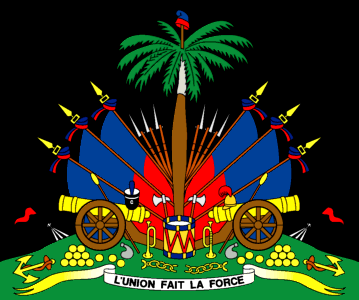
In the south and the western part of the country, Alexandre Petion went back to 1804's flag that was blue and red only this time he added the white squared portion that included the country arms and the famous phrase "L'UNION FAIT LA FORCE", meaning that through unity we find strength.


That flag was in use until 1964 when Papa Doc Duvalier brought back the black and red flag of Dessalines and added a modified version of the arms of the Republic.

On February 25 1986, after the fall of Baby Doc and the Duvalier regime, the people requested that the red and blue flag be brought back. The constitution of 1987 describes the new flag in these terms:

The emblem of the Haitian Nation shall be a flag with the following description:

a) Two (2) equal-sized horizontal bands: a blue one on top and a red one underneath.

b) The coat of arms of the Republic shall be placed in the center on a white square.

c) The coat of arms of the Republic will be a Palm tree surmounted by the liberty cap and under the palms a trophy with the legend: In Union there is Strength.
Photo Sharing and Video Hosting at Photobucket

That is the flag used until today.
Photo Sharing and Video Hosting at Photobucket


Source: http://www.discoverhaiti.com/history00_5_1.htm

How warm is it?

Warm temperature, ranging year-round from 70-93° F in the coastal regions, and 50-75 in the mountainous areas; rainy seasons are April-May and August-October.

Enjoy the music!


You might be going through some tough time and you feel like you can not take it anymore. Remember there is a friend who cares and his name is Jesus. He says cast all your care upon him for he caress for you. He will give you rest! The road might be treacherous, nevertheless, don't ever give up!

It is time...

Time does not stand still. So, Make the best use of it!